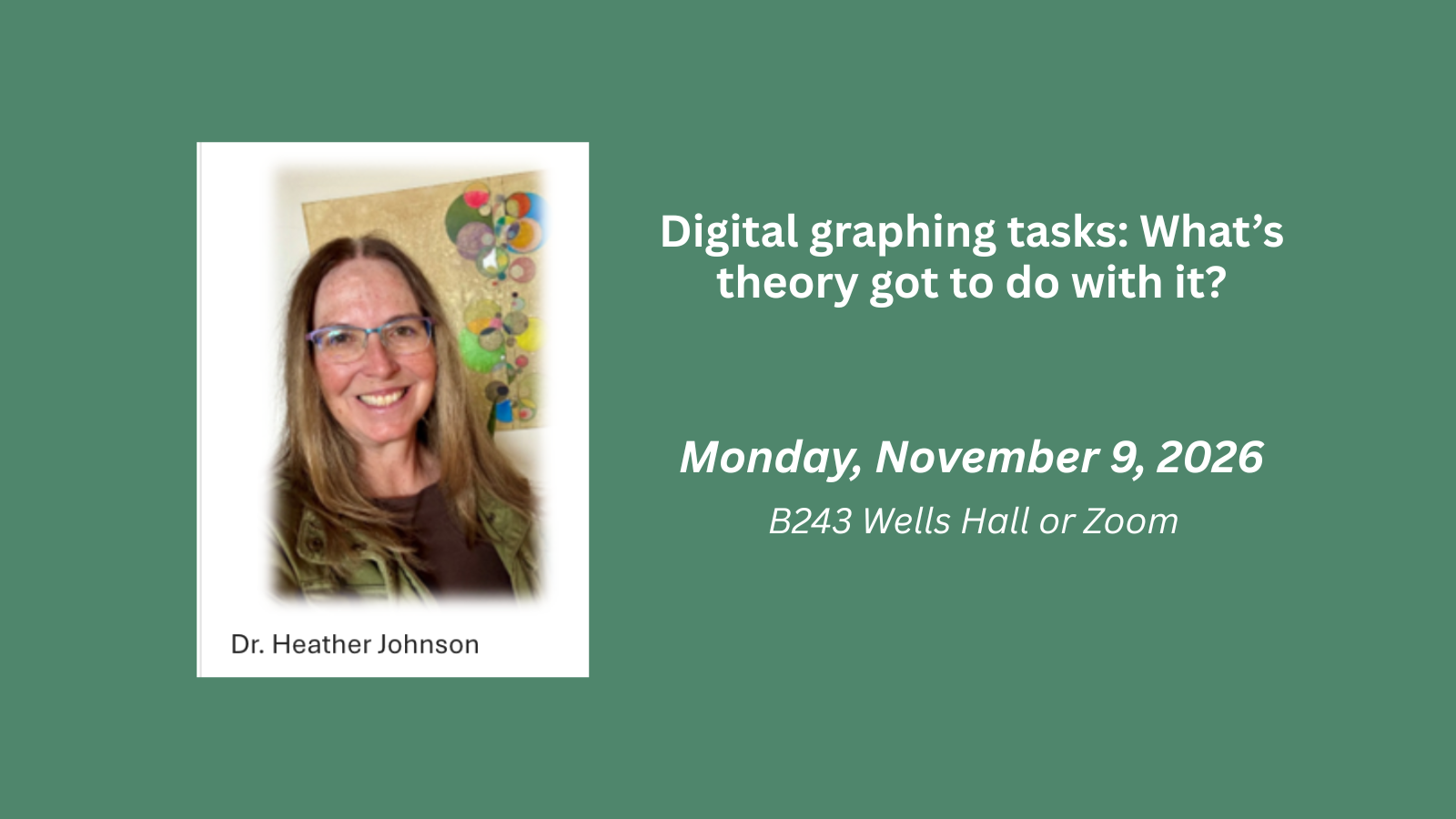
MSU's Program in Mathematics Education is proud to welcome Dr. Heather Johnson, Professor of Mathematics Education at the University of Colorado, Denver, on Monday, November 9th at 3:30pm. Dr. Johnson's research focuses on theoretical working, task design, mathematical reasoning, and instructional change. This is an in-person event, with a Zoom option:
Zoom Information: https://msu.zoom.us/j/98755354074 Meeting ID: 987 5535 4074; Passcode: PRIME
Abstract: In mathematics education, there is a need to raise the status of reasoning, to disrupt the power of answer-finding. I draw connections between different aspects of my research program to explain how theory informed the design of digital graphing tasks and the study of their implementation. Thousands of students have used the See How Graphs Work tasks (“techtivities”) that I collaboratively developed with colleagues at Amplify Classroom, to promote students’ reasoning. To make explicit the assumptions underlying the tasks, I share how and why I combined Variation Theory and the Theory of Quantitative Reasoning to design the techtivities. Next, drawing on Community of Practice Theory, I explain how a College Algebra instructor engaged in “boundary transitions” when using the techtivities, to communicate to students that their reasoning mattered. Then I describe how my colleagues and I used the Theorizing of Positioning to develop principles for task-based interviews, to position students as experts in their mathematical thinking. I conclude with discussion around the role of theory throughout different stages of a research program.
Bio: Heather Lynn Johnson is a professor of mathematics education at the University of Colorado Denver. Her research focuses on theoretical working, task design, mathematical reasoning, and instructional change. Johnson studies students’ reasoning and designs tasks to help students to expand their reasoning. She also studies how instructors and departments transform practices to disrupt the power of answer-finding in mathematics, to raise the status of reasoning. In addition, Johnson leads international conversations around theoretical perspectives and approaches in mathematics education. She is a co-editor of a forthcoming Springer book, How Theories Work in Mathematics Education Research— Foundation, Form, and Function. Johnson is an editor at Mathematical Thinking and Learning. For more, visit https://hthrlynnj.com/.